Traditional online learning platforms are mostly built around static content: videos, documents, quizzes, and predefined learning paths.
But real learning does not work that way.
Human teachers continuously adapt based on discussion, feedback, engagement, assessment results, and the learner's current level of understanding. They do not start every session with a quiz. They start by understanding the student.
This is where AI agents become interesting.
Instead of using a single chatbot, AI-driven lesson delivery can use multiple specialised agents working together to create a far more personalised and adaptive learning experience. The goal is not to simulate a chatbot. It is to simulate how real teaching teams work.
The Problem with Traditional Learning Platforms
Most online learning systems share the same limitations:
- Fixed content: every learner follows the same path regardless of what they already know
- Low engagement: passive consumption of videos and PDFs with little interaction
- No adaptation: difficulty and pacing stay the same even when a learner is struggling or bored
- Limited personalisation: at best, a recommendation engine suggests the next module
These platforms deliver information. They do not deliver teaching.
Real teaching is conversational, responsive, and iterative. A good instructor reads the room, adjusts explanations, checks understanding, and changes direction when something is not landing. That dynamic behaviour is exactly what multi-agent AI systems can replicate when they are designed as coordinated workflows rather than single prompts.
AI-Driven Lesson Delivery: A Multi-Agent Workflow
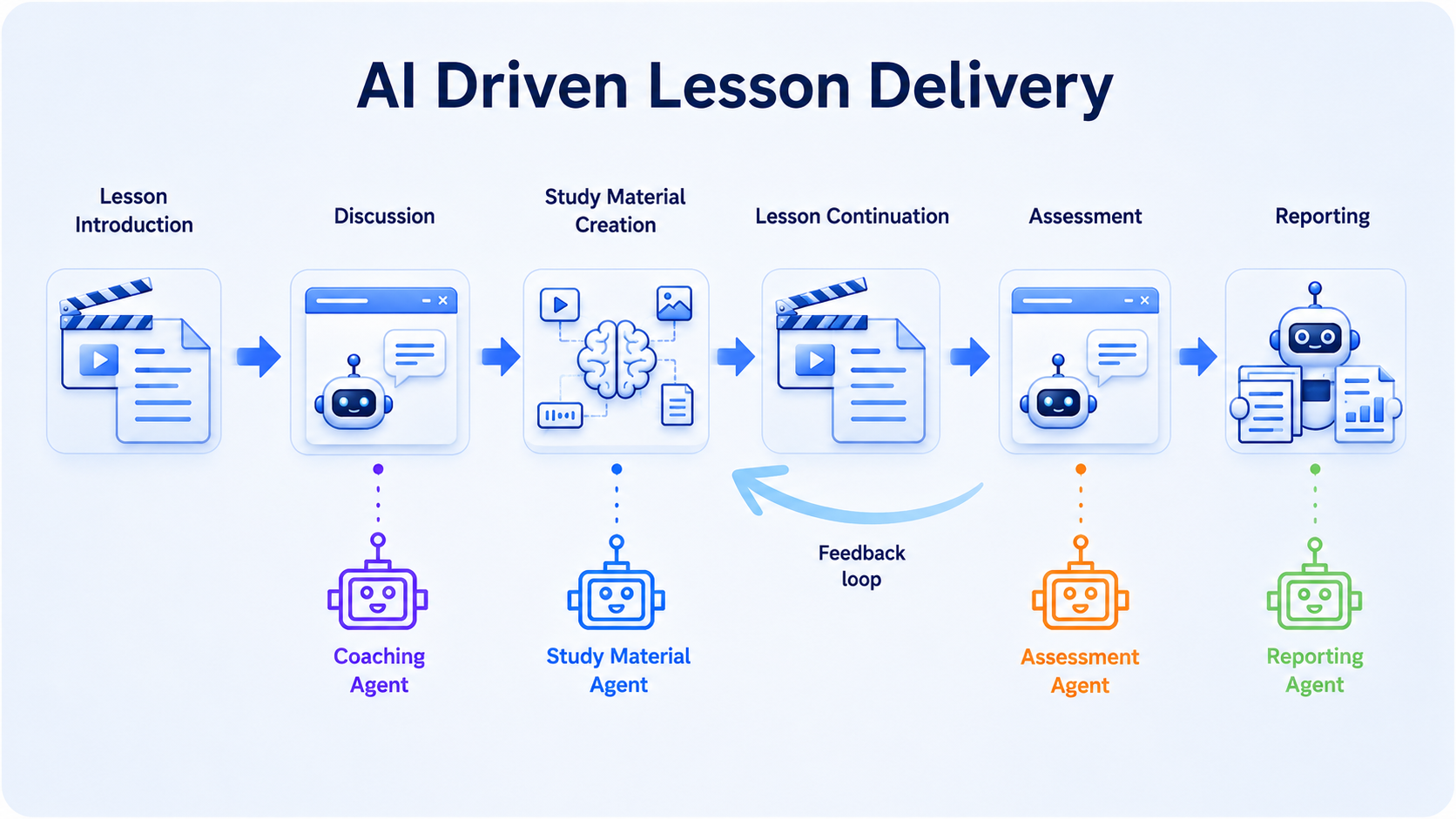
The diagram above shows an end-to-end lesson delivery pipeline powered by multiple AI agents. Each stage maps to a distinct responsibility, and each responsibility is handled by a specialised agent rather than one general-purpose model trying to do everything.
1. Lesson Introduction
The session begins with context: what the learner is about to study, why it matters, and how it connects to their goals. This is the equivalent of a trainer opening a session: setting expectations and framing the topic before diving in.
2. Discussion
The lesson does not start with a quiz. It starts with conversation.
A Coaching Agent leads this stage, responsible for:
- understanding the learner's current knowledge
- engaging in discussion to surface gaps and misconceptions
- connecting the lesson to the learner's context and motivation
- building rapport and maintaining engagement
AI should not just deliver information. It should understand the learner first. This discussion stage simulates how a human coach or trainer opens a session: exploring what the student already knows before deciding what to teach next.
3. Study Material Creation
Once the Coaching Agent has identified what the learner needs, a Study Material Agent generates personalised content:
- adapting difficulty to the learner's level
- simplifying concepts where gaps were identified
- creating relevant examples tied to the learner's context
- producing material in multiple formats: text, video scripts, audio, and visual content
This agent does not pull from a static library. It generates material dynamically based on what the discussion revealed.
4. Lesson Continuation
With personalised material in place, the lesson continues, revisiting topics, deepening understanding, and moving forward at an appropriate pace. This stage loops back into discussion and material creation as needed.
The feedback loop shown in the diagram is what separates this from a linear content delivery system. Assessment results and ongoing discussion feed back into future material and coaching, so the system continuously adjusts rather than following a fixed path.
5. Assessment
An Assessment Agent evaluates understanding:
- testing comprehension of key concepts
- identifying weak areas that need reinforcement
- measuring progress against learning objectives
- generating targeted questions rather than generic quizzes
Assessment here is not a final exam bolted onto the end. It is an ongoing diagnostic that informs what happens next.
6. Reporting
A Reporting Agent provides visibility into the learning journey:
- progress tracking across sessions
- summaries of strengths and gaps
- analytics for instructors, managers, or compliance teams
- evidence of completion for accreditation or certification
This stage ensures that adaptive learning is not invisible. Stakeholders can see what was covered, what was understood, and what still needs attention.
Why Multi-Agent Systems Matter
A single AI prompt becomes difficult to manage when the workflow grows. Different responsibilities require different prompts, memory scopes, tools, models, and orchestration logic.
Multi-agent systems solve this naturally.
In PrimePilot, this maps directly to the platform's core architecture:
- Agents: specialised execution units, each with its own configuration, knowledge base, and tools. A Coaching Agent and an Assessment Agent can use different models, prompts, and guardrails.
- Squads: collections of agents with orchestration capabilities. A lesson delivery squad coordinates the Coaching, Study Material, Assessment, and Reporting agents as a team.
- Orchestrators: runtime coordinators that define how agents execute. A sequential orchestrator might run Discussion → Material → Assessment in order; a planner pattern might route dynamically based on learner responses.
- Listeners: event triggers that start the workflow. A scheduled listener could begin a daily training session; a webhook could trigger onboarding when a new employee joins.
Trying to handle all of this in one prompt (coaching, content generation, assessment design, and reporting) produces inconsistent results and becomes impossible to maintain. Splitting responsibilities across agents keeps each one focused, testable, and improvable independently.
The Importance of Feedback Loops
Most AI education demos stop at: generate a lesson, ask some questions, give a score.
The real value comes from the feedback loop.
When assessment results feed back into future discussions, next lessons, material complexity, and pacing, learning becomes adaptive instead of static. The system continuously adjusts itself based on student understanding rather than following a fixed content path.
This is the difference between:
- Static AI tutoring: generate content once, deliver it, move on
- Adaptive AI teaching: observe, adjust, reassess, and repeat
The feedback loop in the diagram connects Lesson Continuation back to earlier stages. If a learner struggles with a concept during assessment, the Coaching Agent can revisit it in the next discussion. The Study Material Agent can regenerate content at a simpler level. The pace slows or accelerates based on actual comprehension, not a predetermined schedule.
Without this loop, you have a content generator. With it, you have a learning system.
Memory and Long-Term Learning
AI learning becomes significantly more powerful once the system remembers the learner over time.
Agent memory allows the lesson delivery squad to persist context across sessions:
- previous lessons and topics covered
- identified weak areas and recurring gaps
- learner preferences and engagement patterns
- past discussions and assessment history
- progress toward learning objectives
Without memory, every session starts from zero. The Coaching Agent asks the same introductory questions. The Study Material Agent generates generic content. The Assessment Agent has no baseline for measuring improvement.
With memory scoped appropriately (per squad, per agent, or per run depending on the orchestration need), the system builds a longitudinal picture of each learner. Session five is informed by sessions one through four. The feedback loop operates across weeks and months, not just within a single interaction.
This is a natural continuation of the agent memory concept: long-running, multi-step flows where each stage saves data for the next are exactly where persistent memory delivers the most value.
AI Workspaces Instead of Simple Chatbots
This is not "just a chatbot."
It is a structured AI workspace, an operational interface that combines lesson delivery, interaction, content generation, assessment, and reporting in one place.
PrimePilot workspaces are feature-rich interfaces bound to squads. Unlike a chat widget embedded on a website, a workspace is a hosted environment designed for a specific workflow. For lesson delivery, that means:
- a module progress view showing where the learner is in the curriculum
- structured interaction areas for discussion and study material
- assessment interfaces with immediate feedback
- reporting dashboards for instructors and administrators
- agent assistance woven into every stage of the experience
This is closer to an AI learning operating system than a conversational assistant. The workspace provides the structure; the squad provides the intelligence; the orchestrator provides the coordination; memory provides the continuity.
Real-World Applications
Multi-agent lesson delivery is not limited to academic education. Any organisation that needs to teach, train, or transfer knowledge can benefit.
Corporate Training
- Onboarding: personalised induction programmes that adapt to each new hire's background and role
- Compliance training: adaptive modules with assessment evidence and reporting for audit trails
- Product training: dynamic material generation based on what sales or support teams already know
Education
- Personalised tutoring: one-to-one coaching that adjusts to each student's pace and gaps
- Assignment support: discussion and material generation tied to specific coursework
- Adaptive learning paths: curricula that reshape based on ongoing assessment
Professional Development
- Sales coaching: scenario-based discussion, personalised practice material, and performance assessment
- Technical training: hands-on material generation at the right difficulty level
- Certification preparation: targeted study material and practice assessments focused on weak areas
Internal Knowledge Transfer
- Company process training: SOP delivery with discussion to confirm understanding
- Operational learning: role-specific material generated from internal knowledge bases
- Cross-team knowledge sharing: structured learning workflows that capture and transfer expertise
In each case, the pattern is the same: multiple agents, coordinated through a squad, delivered through a workspace, with memory and feedback loops making the experience adaptive over time.
Final Thoughts
The future of AI in education is probably not a single tutor bot.
It is coordinated AI systems where specialised agents collaborate, remember context, adapt learning paths, and continuously improve the learning experience through feedback loops.
Traditional platforms deliver content. Multi-agent systems deliver teaching, with discussion before assessment, personalised material instead of generic modules, and feedback loops that make every session better informed than the last.
If you are building AI-powered learning or training experiences, the question is not whether to use AI. It is whether to use one AI doing everything, or a team of agents each doing what they do best, orchestrated, remembered, and delivered through a workspace built for the job.