Many organisations are experimenting with AI today. They build chatbots, internal assistants, workflow automations, and AI-driven knowledge systems.
However, most teams quickly discover that building an AI solution involves far more than connecting to a language model.
A production-ready AI system requires:
- orchestration between multiple AI agents
- knowledge retrieval systems
- integration with external tools and APIs
- monitoring and observability
- safety controls and guardrails
- deployment interfaces for users and applications
Most companies end up rebuilding this infrastructure repeatedly for every project.
PrimePilot was created to solve this problem.
Instead of treating AI as isolated experiments, PrimePilot provides a modular platform that acts as the foundational infrastructure for organisational AI systems.
With this foundation in place, organisations can build new AI capabilities quickly without rebuilding the underlying architecture every time.
The Shift From AI Projects to AI Infrastructure
The first wave of AI adoption focused on individual applications:
- a customer service chatbot
- an internal knowledge assistant
- a document analysis tool
- an email automation agent
Each project required its own infrastructure, integrations, and orchestration logic.
This approach works for experimentation but does not scale well.
As organisations begin deploying multiple AI solutions, they need a shared platform that supports all of them.
PrimePilot provides that platform.
It allows organisations to build many AI solutions on top of a single, reusable architecture.
Instead of building separate AI systems, organisations can develop an AI ecosystem.
The PrimePilot Architecture
PrimePilot is built as a modular architecture composed of reusable components. Each component plays a specific role in enabling intelligent systems.
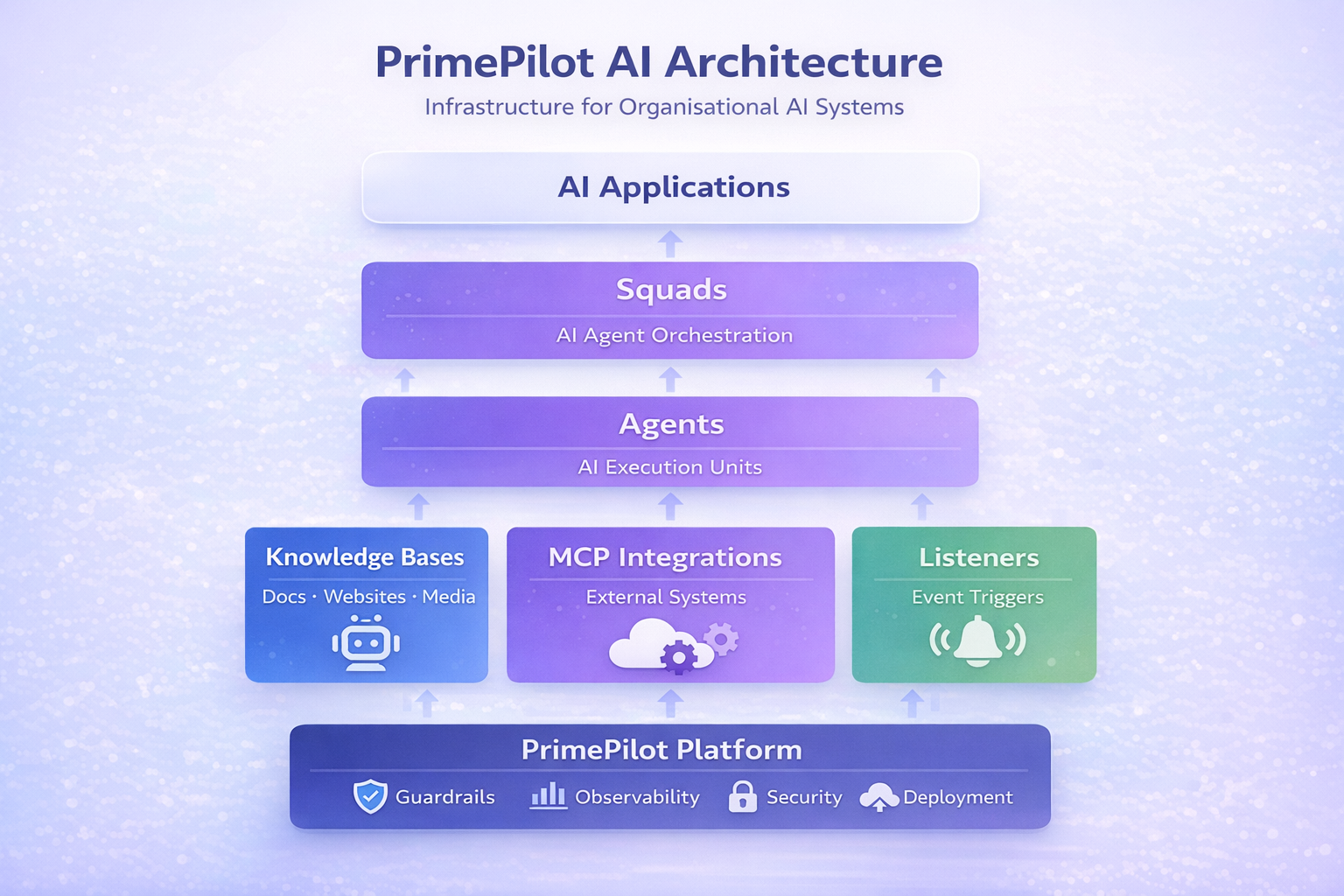
This architecture allows organisations to build AI capabilities by configuring components instead of building infrastructure.
Core Building Blocks
Agents
Agents are the core execution units of PrimePilot.
An agent receives input and produces an output using a language model, knowledge base, or external tools.
Different types of agents can perform different tasks:
- reasoning and conversation
- knowledge retrieval
- tool execution
- workflow automation
Agents represent the intelligence layer of the system.
Squads
Squads orchestrate multiple agents together.
Rather than relying on a single AI model to solve every problem, squads allow specialised agents to collaborate.
For example:
- a routing agent detects user intent
- a knowledge agent retrieves relevant information
- a tool agent performs actions in external systems
This multi-agent orchestration enables far more powerful AI workflows.
Knowledge Bases
Knowledge bases allow organisations to train agents on their own information.
Sources may include:
- documents
- websites
- videos and audio
- images
- structured data
Through retrieval-augmented generation (RAG), agents can provide accurate, domain-specific answers based on organisational knowledge.
MCP Integrations
Modern AI systems must interact with external tools.
PrimePilot supports integrations through MCP (Model Context Protocol) agents.
This allows agents to interact with systems such as:
- CRMs
- accounting systems
- project management tools
- internal APIs
AI agents can therefore move beyond answering questions and perform real actions.
Listeners
Listeners allow AI workflows to run automatically when events occur.
Examples include:
- receiving an email
- a webhook from another system
- a scheduled trigger
This enables automated workflows such as:
- email response agents
- monitoring systems
- scheduled report generation
Built-In Platform Capabilities
Beyond the core architecture, PrimePilot includes critical infrastructure features required for production AI systems.
These include:
Observability - Organisations can monitor agent behaviour, conversations, and system performance.
Guardrails - Safety controls ensure agents behave within defined boundaries.
Security - Authentication, API keys, and domain restrictions protect deployments.
Deployment Options - Solutions can be deployed as:
- website chat widgets
- full-page AI assistants
- API integrations
- embedded application components
This infrastructure ensures AI systems remain reliable, safe, and scalable.
Building an Organisational AI Brain
The long-term vision of PrimePilot is not simply to build individual AI tools.
It is to help organisations build a shared AI capability that evolves over time.
As more agents and knowledge bases are added, the system gradually becomes an organisational intelligence layer.
New AI solutions can be created by connecting to this growing ecosystem rather than starting from scratch.
Over time, PrimePilot becomes the AI brain of the organisation.
The Future of AI Platforms
The next generation of software platforms will not just host applications.
They will host intelligent systems.
These systems will consist of:
- agents that reason
- knowledge bases that store organisational memory
- orchestration layers that coordinate intelligence
- integrations that connect AI to real-world systems
PrimePilot is designed to provide exactly this foundation.
Instead of building AI infrastructure repeatedly, organisations can build it once - and continuously expand their AI capabilities on top of it.